The best cuts for round faces do not exist to make anyone’s face look less round. They exist to create a shape that feels intentional: soft where you want softness, defined where you want definition, and easy enough to wear on an ordinary Tuesday. A great cut considers face shape, but it also has to respect your texture, density, growth patterns, styling routine, and personal taste.
Round faces are typically similar in width and length, with fuller cheeks and gently curved lines around the jaw and forehead. That is useful information for a stylist, not a rulebook. Some people want a cut that creates more vertical movement or a little structure around the cheekbones. Others love the openness and softness of their face shape and simply want hair that supports it. Both approaches can be beautiful.
What Makes a Haircut Work for a Round Face?
The most flattering haircuts for round faces often use placement rather than disguise. Length below the chin, subtle height at the crown, face-framing layers that begin below the widest part of the cheeks, and an off-center or softly shifted part can all change the visual balance of a style.
The key is avoiding a one-size-fits-all formula. A sleek center part and blunt bob can look striking on one person with a round face, while another may prefer airy layers and a side fringe. Hair density matters too. Fine hair can lose its shape under too many layers, while dense hair may need internal weight removal to keep a lob or shag from expanding outward.
A consultation should also account for how you actually wear your hair. If you regularly pull it into a ponytail, work in Jacksonville humidity, wear glasses, or prefer a wash-and-go routine, the cut needs to cooperate with that reality.
Long Layers Create Movement Without Losing Length
Long layers are often a natural starting point for people who want to keep their hair long. When the shortest layers begin below the cheekbone or near the jaw, they create movement without adding unnecessary width at the sides of the face. The result can feel soft, romantic, polished, or a little undone depending on how it is styled.
For straight or wavy hair, long layers prevent the familiar heavy-triangle effect: hair that lies flat at the crown and becomes broad through the ends. A few carefully placed layers can encourage lift and movement while maintaining a substantial perimeter. For someone with finer hair, the layering should be restrained. Too much can make the ends look wispy and leave the overall shape less intentional.
Long hair also offers flexibility. A center part can feel modern and clean, while a slightly off-center part adds asymmetry. Loose waves should generally start around the cheekbones or lower rather than puffing out directly beside the temples if your goal is a more elongated silhouette.
Face-Framing Layers Need a Precise Starting Point
The phrase “face-framing layers” gets used often, but the placement makes all the difference. A short, rounded layer that flips outward at the cheeks can emphasize width. That may be exactly the effect someone wants, especially in a playful, voluminous style. If not, starting the framing closer to the cheekbone, jaw, or collarbone creates a more vertical line.
This is why a picture alone is not enough. The same haircut reference can land very differently on fine straight hair, thick waves, or tight curls.
The Collarbone Lob Is a Reliable Favorite
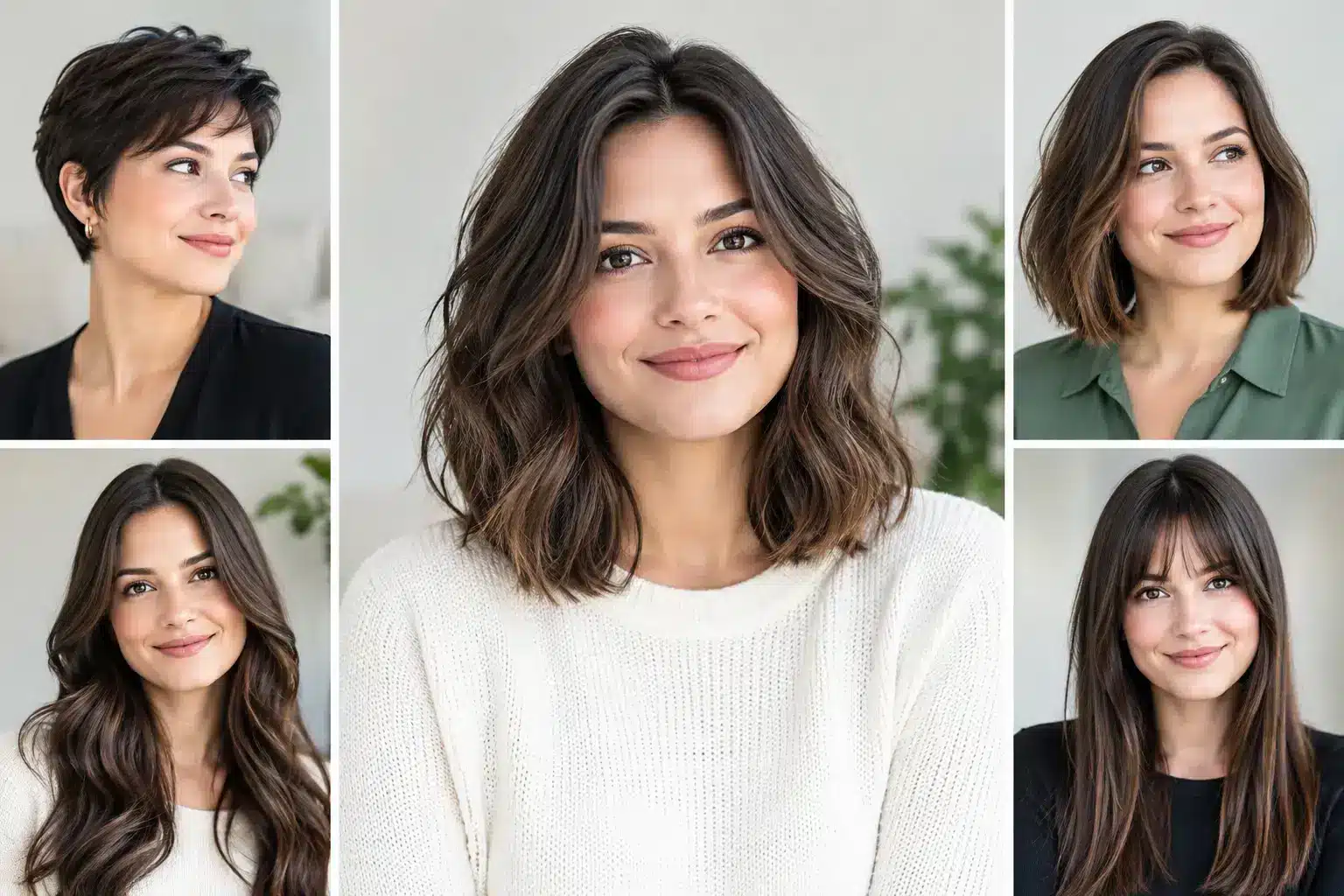
A lob, or long bob, that falls between the collarbone and upper chest is one of the most versatile cuts for round faces. It has enough length to create a graceful vertical line, yet it still feels fresh and tailored. A blunt or gently softened perimeter can give fine hair a fuller appearance, while hidden internal layers can remove bulk from thicker hair.
For a round face, the most adaptable version is often slightly longer in front or softly angled rather than dramatically stacked. The angle does not need to be obvious. Even a subtle forward length can guide the eye downward and make the cut feel more sculpted.
A lob is also a good choice for clients who want something that can move between polished and casual. Blow it smooth for clean, graphic lines, add a bend through the mid-lengths for softness, or air-dry it with a texture-enhancing product if your natural wave has enough support. The trade-off is that a lob needs regular shape maintenance. Once it grows past its intended balance point, it can begin to feel heavy or awkward around the shoulders.
A Textured Pixie Can Be Beautifully Balanced
Short hair is not off-limits for a round face. In fact, a textured pixie can be one of the most expressive options when it is designed with intention. A little extra length and lift through the crown, combined with texture around the top, can create a more vertical direction. A side-swept fringe or longer piece through the front can add softness and movement.
The important distinction is between a pixie that is cropped close everywhere and one that has a considered silhouette. Very short sides can be chic and bold, but they put the face fully on display. A softer pixie with varied lengths gives more options for styling and can feel less exposing during the grow-out process.
This cut works especially well for clients who enjoy showing their features, earrings, makeup, or personal style. It is not necessarily low-maintenance, though. Short hair is often low-effort day to day, but it tends to need more frequent appointments to preserve its shape.
Bangs Are About Proportion, Not Permission
Bangs are frequently treated as forbidden territory for round faces, which is far too simplistic. The right fringe can look fantastic. The question is whether the fringe creates a shape you enjoy and whether you are willing to style it.
Long curtain bangs that open around the cheekbones can blend into layers and offer softness without creating a hard horizontal line. A wispy, slightly separated fringe can also work well, particularly with a layered bob or shag. Side-swept bangs remain a strong option because they introduce an asymmetrical diagonal across the forehead.
Full blunt bangs can absolutely be a creative choice, especially paired with longer hair or a sharp bob. They place emphasis on the eyes and can feel graphic and fashion-forward. The trade-off is balance: if the rest of the cut is also very rounded and wide, the overall shape may feel more compact. Adding length, texture, or a cleaner line elsewhere can keep the style from becoming overly circular.
Curly Cuts Need to Follow the Curl Pattern
For naturally curly or textured hair, the best shape is not created by forcing curls into a straight-hair blueprint. Curls have their own architecture. They shrink, expand, cluster, separate, and react to humidity, so a round-face haircut must account for where the curl lives when it is dry.
A well-shaped curly cut can create height at the crown and release weight in the right places without turning the hair into a round halo. That might mean longer pieces through the front, strategic internal shaping, or a silhouette that is slightly taller than it is wide. It does not mean removing bulk indiscriminately. Over-thinning curls can lead to frizz, uneven clumps, and a shape that falls apart between appointments.
Dry cutting is especially valuable when a curl pattern has a lot of variation. It allows the stylist to see the true length, density, and direction of each section before deciding where to create volume or remove weight. At Richard McGraw Hair Design, this individualized approach is central to curly-hair work because the goal is not merely a good salon-day result. It is a cut you can understand, style, and enjoy at home.
Color Can Support the Shape of the Cut
Color does not change face shape, but thoughtful placement can reinforce a haircut’s movement. Dimensional highlights around the face can draw attention upward or create a brighter focal point near the eyes. A lived-in balayage can emphasize long layers, while deeper root depth may make the overall style feel more grounded.
The most natural-looking color placement follows the haircut rather than competing with it. On a lob, a few brighter pieces toward the front can enhance the angle. On curls, painted color should respect the way the hair clusters and moves. On a pixie, contrast can highlight texture and make the cut feel even more deliberate.
Bring Your Preferences, Not Just a Face-Shape Label
Face shape is one useful piece of the design conversation, but it should never overrule your identity. If you love chin-length bobs, full bangs, big curls, or sleek center parts, that preference matters. A skilled stylist can adjust length, weight, parting, and texture so the style feels like a choice rather than a compromise.
Bring inspiration photos, but also describe what you like about them. Is it the length? The confidence? The softness around the face? The ease of styling? That information gives your stylist something more valuable than a label. The right haircut should not ask you to become someone else. It should make the version of you in the mirror feel more clearly expressed.